
Infineon SP370: A Comprehensive Analysis of Its High-Performance Automotive Radar IC Technology
The relentless advancement of automotive safety and autonomous driving is fundamentally powered by sophisticated sensor technology. At the heart of this evolution lies radar, a critical sensor for robust, all-weather object detection. The Infineon SP370 stands as a pinnacle of this technology, representing a significant leap forward in high-performance radar integrated circuit (IC) design. This article provides a comprehensive analysis of its groundbreaking features and the technological prowess it brings to modern vehicles.
As a 77 GHz monolithic microwave integrated circuit (MMIC), the SP370 is engineered for long-range radar (LRR) and mid-range radar (MRR) applications. These systems are indispensable for advanced driver-assistance systems (ADAS) functionalities like adaptive cruise control (ACC), automatic emergency braking (AEB), and cross-traffic alert. The chip's operation in the 76–81 GHz frequency band offers substantial advantages over previous 24 GHz systems, including markedly superior resolution and accuracy. This enables the radar to not only detect objects at greater distances but also to distinguish between two closely spaced objects, a critical requirement for complex urban driving scenarios.
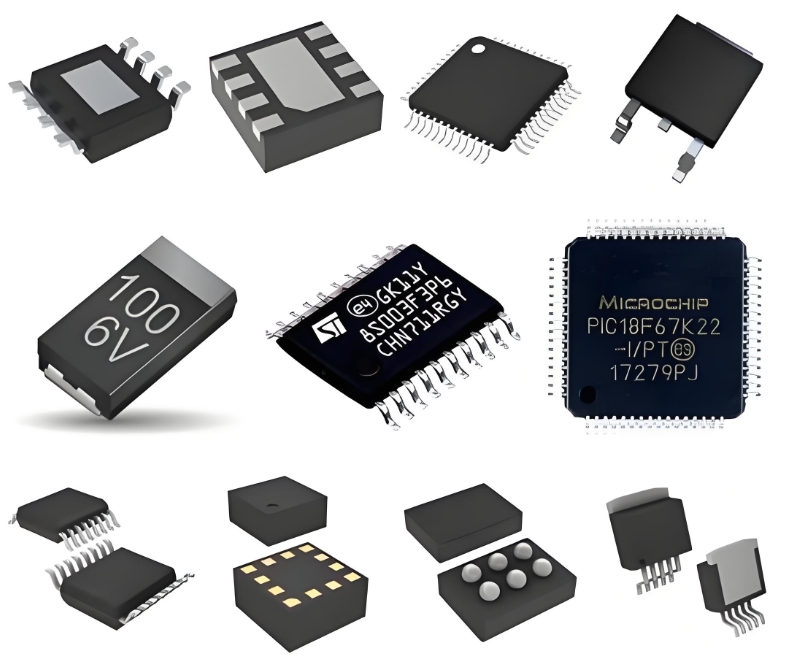
A key innovation of the SP370 is its fully integrated single-chip architecture. It ingeniously combines multiple critical functions onto a single piece of silicon: a transmitter (Tx), a receiver (Rx) with four channels, a phase-locked loop (PLL), and an analog-to-digital converter (ADC). This high level of integration is a monumental achievement in MMIC design. It drastically reduces the system's overall size, weight, and bill-of-materials (BOM) complexity. For automotive manufacturers, this translates into more compact radar modules that are easier to integrate into a vehicle's design, all while enhancing overall reliability by minimizing external component count.
Furthermore, the SP370 is architected for exceptional performance and scalability. The four independent receive channels allow for the application of advanced digital beamforming techniques. This enables the radar sensor to accurately estimate the angle of arrival of reflected signals, creating a high-resolution spatial awareness of the vehicle's surroundings. When multiple SP370 chips are synchronized, they can form a cohesive imaging radar system, effectively creating a detailed "picture" of the environment. This capability is a cornerstone for achieving higher levels of autonomous driving (L3 and beyond), where situational awareness is paramount.
Beyond raw performance, Infineon has designed the SP370 with the stringent demands of the automotive industry in mind. It is built to withstand harsh operating conditions, including extreme temperatures and vibrations, ensuring consistent performance over the vehicle's entire lifetime. Its design also focuses on functional safety, adhering to standards like ISO 26262, which is essential for any component responsible for human safety.
ICGOOODFIND: The Infineon SP370 is not merely an incremental update but a transformative radar IC that sets a new benchmark for the industry. Its highly integrated single-chip design, operation in the 76–81 GHz band, and support for advanced beamforming empower the next generation of ADAS and autonomous driving systems. By delivering unparalleled resolution, accuracy, and reliability in a compact form factor, the SP370 is accelerating the deployment of safer, more intelligent vehicles on roads worldwide.
Keywords: Automotive Radar, 77 GHz MMIC, ADAS, Beamforming, Single-Chip Integration

